
Elon Musk, CEO of SpaceX, stated that Starlink's services in India must be affordable for widespread adoption and that competition would benefit consumers, despite potentially reducing Reliance Jio's profits. He criticised Reliance Jio as a 'de facto monopoly' in India, alleging that certain business conglomerates were blocking Starlink's entry.

PM Modi on Sunday called upon states to "speed up capital expenditure and infrastructure creation" to spur economic growth.

80-85 per cent of about 700 major infrastructure projects within the Centre's domain have been delayed.

Ahead of the Parliament session, Prime Minister Narendra Modi on Wednesday reached out to parties appealing them not to come in the way of prosperity of farmers, saying the deadlock over the land acquisition bill is seriously impacting rural development.
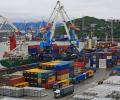
Maharashtra has pipped Tamil Nadu in NITI Aayog's latest Export Preparedness Index (EPI) for 2024. While Gujarat, Uttar Pradesh and Andhra Pradesh gained ground, Karnataka and Haryana slipped out of the top five, the central government think tank said in its report released on Wednesday.
Kumar had accused the Congress of promising the moon to win elections.

Kerala has again emerged as the top ranking state in terms of overall health performance among larger states, while Uttar Pradesh is the worst, according to the fourth Health Index launched by Niti Aayog.

A NITI Aayog report indicates that India's digital public infrastructure (DPI) initiatives are projected to contribute significantly to the nation's GDP, potentially reaching 4 per cent by 2030.

Veteran physicist Professor Umesh V Waghmare has been appointed as the Secretary of the Department of Science and Technology. Currently a professor at JNCASR, Bengaluru, his appointment was approved by the Appointments Committee of the Cabinet. He succeeds Professor Abhay Karandikar and brings a distinguished academic background from IIT-Bombay, Yale, and Harvard to the role.

The Centre has announced a major bureaucratic reshuffle, appointing Prakash Rajpurohit as Deputy Election Commissioner and approving appointments for 27 civil servants at joint secretary and equivalent levels across various ministries and departments.

Arundhati Bhattacharyya, Salesforce President and CEO for South Asia, highlighted how cloud and AI are democratising capabilities, offering India a unique opportunity to leapfrog in the technology revolution. Speaking at the IMC Chamber of Commerce, she emphasised that AI will create more jobs by addressing unmet business demands and could significantly boost India's GDP, with NITI Aayog estimating a USD 500-600 billion addition by 2035. She urged Indian businesses to transform using technology, focus on data, redesign work, and invest in skills, stressing that AI is not just for large corporations.
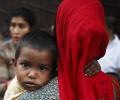
The 14-member task-force will develop a working definition of poverty.
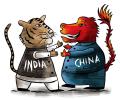
India should have strong trading arrangements with its neighbours including China, which is a USD 18 trillion economy that cannot be avoided, NITI Aayog CEO BVR Subrahmanyam has said.

Rahul Gandhi has ignited a political storm by accusing Prime Minister Narendra Modi, Amit Shah, RSS chief Mohan Bhagwat, and CEC Gyanesh Kumar of "vote chori" and "treason".
NITI Aayog has a dual role of a monitor and advisor.

Aayog to present its performance review - since its existence - before the governing council

As farmers continue their protests demanding repealing of the three new laws, Kumar also emphasised that continued negotiations with protesting farmers is of course the way forward.
A NITI Aayog report indicates that India's digital public infrastructure (DPI) initiatives could contribute 4 per cent of the GDP by 2030, a significant increase from the current 1 per cent.

India's economic growth is likely to reach pre-COVID-19 levels by the end of the 2021-22 fiscal as the GDP contraction in this financial year is expected to be less than 8 per cent, Niti Aayog vice chairman Rajiv Kumar said on Sunday. The Reserve Bank of India (RBI) has also revised its forecast of economic growth for the current fiscal year (2020-21) to (-)7.5 per cent as against its earlier forecast of (-)9.5 per cent.

Representatives from four states including Maharashtra and Karnataka will also be members of the panel.
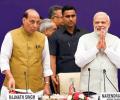
Chief ministers of states like Andhra Pradesh, Kerala and Karnataka were among those who raised the issue of loan waver scheme for farmers.
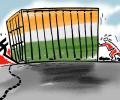
The United States and the European Union have strongly criticised India's trade policies at the World Trade Organization review, highlighting concerns over high tariffs, quality-control orders (QCOs), and restrictions on digital trade and services, which they argue undermine India's economic openness.

Prime Minister Narendra Modi has urged states to balance the opportunities presented by artificial intelligence with the need to safeguard against social challenges like cyber fraud and drug abuse. He also warned of the risks posed by El Nino conditions, calling for stronger water conservation measures and emphasising the collective resolve towards a 'Viksit Bharat'.

The number of individuals who declared a gross income of Rs 100 crore or more in their income-tax returns had risen to 301 in 2022-23, moderated slightly to 284 in 2023-24, then climbed to 415 in 2024-25.

The second meeting of the NITI Aayog's governing council, was, however, attended by Bihar Chief Minister Nitish Kumar.
Indian economy is expected to grow 10.5 per cent or more in the current fiscal, Niti Aayog Vice Chairman Rajiv Kumar said on Thursday. Speaking at a virtual conference organised by the Public Affairs Forum of India (PAFI), he also said that modernisation of the retail sector is very much on the cards. "India Purchasing Managers' Index (PMI) for both manufacturing and services has shown a very smart uptick last month. "This (Indian economy) will strengthen even further," he said. "I expect Indian economy to grow 10.5 per cent or higher in FY 22," he noted.

Bibek Debroy raised seven questions about the new institution.

The country's present growth rate is 7.6% and its economy is $1.7 trillion.

High drama unfolded as INDIA bloc leaders, including Rahul Gandhi and Priyanka Gandhi Vadra, marched to the Election Commission headquarters in Delhi, demanding the resignation of Chief Election Commissioner Gyanesh Kumar over alleged irregularities in the Special Intensive Revision of electoral rolls and his misleading statements regarding Supreme Court observations on Form 6.

'AI will be bigger than the advent of the Internet or the harnessing of electricity.' 'India must embrace it with all its might,' says NITI Aayog CEO Amitabh Kant.

All elections in India should happen in a free, fair and synchronised manner to ensure minimum "campaign mode" disruption to governance, the government think tank said in its report released recently.

The Centre intends to consolidate the 44 central labour laws into 5.

Rahul Gandhi led a significant opposition protest in New Delhi, attempting to march to the Election Commission office to allege "vote chori" and demand the CEC's resignation. The protest resulted in a lockdown of Parliament Street, a standoff at the All India Radio premises, and detentions of several opposition MPs, drawing strong reactions from the ruling BJP.

In the next 36 months nearly 25 to 40 per cent of jobs will be under threat from AI and job losses are inevitable.
Niti Aayog has come out with an initiative to improve governance in states.
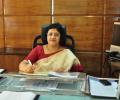
Arundhati Bhattacharya, Salesforce President and CEO for South Asia, stated that cloud and AI are democratising capabilities, offering India a unique opportunity to leapfrog in technology. Speaking at the IMC Chamber of Commerce, she emphasised that AI will create more jobs and urged Indian businesses to transform using technology, rather than merely digitising. She also highlighted the significant economic potential of AI adoption for India.

The Delhi Chief Electoral Officer's office has issued notices to over 33 lakh voters, including former deputy prime minister LK Advani, External Affairs Minister S Jaishankar, and former vice-president Jagdeep Dhankhar, over discrepancies in their electoral roll details. These notices are part of the Special Intensive Revision (SIR) exercise, primarily due to details not matching with the 2002 SIR. Despite concerns raised by some politicians, officials assure that no names will be deleted without due verification and an opportunity for voters to respond.

In a communication sent to Kumar, the EC asked him to be cautious in future while making statements.

A career break does not erase the experience that came before it. But the labour market can act as though it does. The more women invest in building professional careers, the more costly an interruption can become. How, then, do we enable women to make a comeback? Whose responsibility is it? asks Radha Roy Biswas.

A group of experts has voiced significant concerns regarding India's ethanol-blended fuel policy, citing potential negative impacts on land-use, agriculture patterns, food security, groundwater levels, and household incomes. They recommend a return to E10 fuel and a review of the policy's overall benefits versus costs to consumers and the environment.
